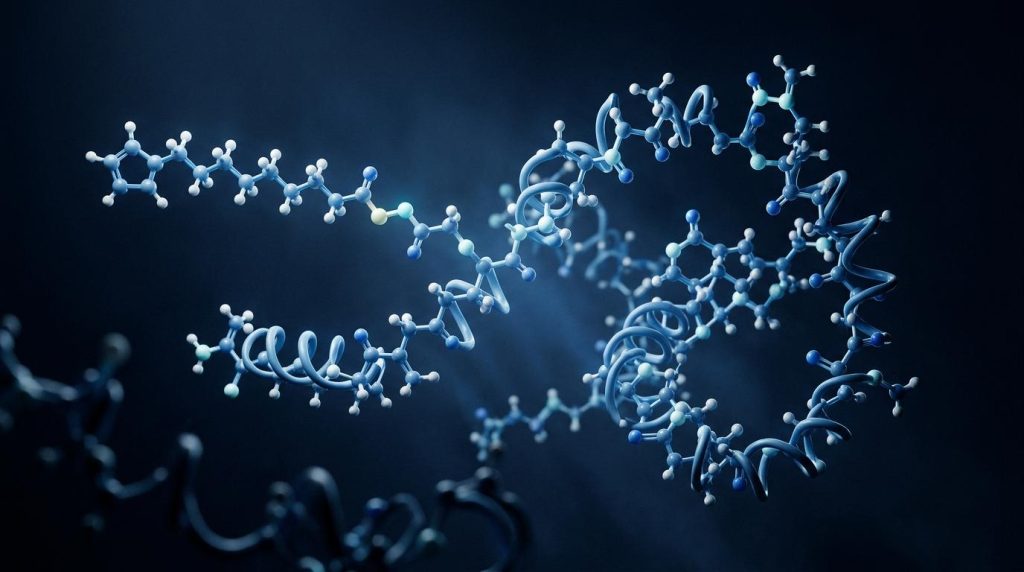
What a peptide is
The IUPAC-IUB Joint Commission on Biochemical Nomenclature defines a peptide as any compound produced by amide formation between a carboxyl group of one amino acid and an amino group of another. That is the whole definition. A peptide is a chain of amino acids joined by amide bonds, and everything else follows from it.
The individual units in the chain are called residues. The bond between them is an amide bond; when it links the alpha-carboxyl position of one residue to the alpha-amino position of the next, the nomenclature calls it a eupeptide bond, and when it links other positions, an isopeptide bond. The chain has two distinguishable ends. The N-terminal residue is the one whose amino group is free, or at least is not acylated by another amino-acid residue. The C-terminal residue is the one with a free carboxyl group, or which at least does not acylate another residue. Sequence is what makes one peptide a different substance from another.
Nothing in that definition mentions research. The phrase research peptide describes an intended use and a supply context, not a chemical class. A peptide sold for laboratory work and a peptide in a licensed medicine can be the same molecule; what differs is the regulatory framework and the evidence attached to it, which the last two sections of this article deal with directly.
Peptide or protein? A convention, not a rule
The most repeated claim about peptides is that a peptide becomes a protein above fifty amino acids. The nomenclature source is considerably less confident than that.
IUPAC-IUB describes oligopeptides as peptides with fewer than about ten to twenty residues, and states that polypeptides of specific sequence of more than about fifty residues are usually known as proteins. The hedging is in the recommendation itself, not added here. Two separate qualifiers appear in a single sentence, and the band between roughly twenty and fifty residues is left without a name.
That imprecision is not an oversight. There is no chemical discontinuity at any particular residue count: the bond chemistry at residue forty-nine is the same as at residue fifty-one. The nomenclature body is recording how chemists conventionally speak, not legislating a physical boundary. Secondary sources drop the hedging because a single number is easier to repeat than a convention with soft edges, which is how an approximation became a rule that the original text does not support.
How research peptides are made
The dominant method is solid-phase peptide synthesis, introduced by R. B. Merrifield in the Journal of the American Chemical Society in 1963. The idea is to add protected amino acids stepwise to a peptide chain that is held by a covalent bond to a solid resin particle. Because the growing chain is anchored to something insoluble, excess reagents can be washed away between steps.
Modern practice is dominated by Fmoc chemistry. A 2016 review in the Journal of Peptide Science describes Fmoc solid-phase synthesis as having become the dominant peptide synthesis method, supported by very-high-quality Fmoc building blocks available at low cost through economies of scale, and by a broad range of commercially available modified derivatives that make synthetic access to a broad range of peptide derivatives straightforward.
The consequence of a stepwise method matters more than the chemistry itself. Each residue is added in a separate cycle, which is why the manufacturing process is itself one of the recognised sources of impurity in a finished peptide, alongside the starting materials and storage conditions. Deletion and truncation sequences are among the impurity classes that arise.
What is actually in the vial
A peptide preparation is a mixture. A 2021 review in the Journal of the American Society for Mass Spectrometry notes that synthetic peptides are subject to many complex structural modifications originating from three distinct places: the starting materials, the manufacturing process, and storage conditions.
Some of that material is analytically awkward. The same review identifies distinguishing structural isomers and stereoisomers, particularly peptide epimers, as a standing challenge.
The rest of the non-target material is not peptide at all. Purification leaves counterions behind, and a 2023 paper in Pharmaceutical Research on reference standards for synthetic peptide therapeutics accounts separately for acetic acid, trifluoroacetic acid, residual solvents, inorganic residues and water. None of those are impurities in the sense of being wrong molecules. They are simply mass in the vial that is not the peptide.
How purity is measured, and what the number leaves out
A purity figure on a certificate is usually a chromatographic measurement. High-performance liquid chromatography separates the components of a sample and the main peak is compared against the total detected peak area. The resulting percentage is a statement about the proportion of detected material attributable to the target sequence.
That qualifier does most of the work. The Pharmaceutical Research reference-standard paper sets out a mass-balance approach in which, for purity assignment, all species other than the native peptide – impurities and counter ions alike – should be identified and measured. It accounts for counterions, residual solvents, inorganic residues and water content as separate determinations precisely because standard chromatographic purity does not see them. A preparation can be highly pure by peak area and still contain mass that is salt and water.
Identity and quantity are also separate questions from purity, and from each other. The same paper describes identity being confirmed by several methods used together – chromatographic retention time, nuclear magnetic resonance, mass spectrometry and chiral testing – while content is assayed against a calibrated standard once bulk purity has been established. Three different numbers answer three different questions.
| Measurement | What it answers | What it does not answer |
|---|---|---|
| Chromatographic purity (peak area) | What proportion of chromatographically detected material is the main peak | How much counterion, water, residual solvent or inorganic residue is present |
| Mass spectrometry and orthogonal identity testing | Whether the material is the sequence it is claimed to be | How much of it there is, and whether epimers or isomers are present without dedicated methods |
| Content assay against a calibrated standard | How much peptide is present by mass | Whether the remaining mass has been characterised |
Reading a real certificate against those three questions is more informative than reading a single headline percentage. Dice makes its published certificates of analysis available, and the distinctions above are the ones worth applying to them.
Why peptides are chemically fragile
The amide bond that defines a peptide is also a target for enzymes that hydrolyse it. A 2021 study in Clinical and Translational Science, which synthesised a peptide library and measured its stability in serum, describes proteolytic degradation as the primary instability mechanism and notes that it occurs mainly in plasma but also in the gastrointestinal system, the liver and in immune cells.
The measured spread in that library was wide. Half-lives ranged from approximately 7.4 to 403.4 minutes – roughly a fifty-fold difference across peptides made in the same laboratory by the same methods. The authors identified four sequence-related properties that correlated with stability: higher nonpolar residue content and the presence of two or more tyrosine residues were associated with longer half-lives, while the presence of tryptophan and a higher isoelectric point were associated with shorter ones. Their predictive model reported an R-squared of 0.76 to 0.78.
Two limits on that finding should be stated plainly. These are in vitro serum measurements on a library designed to probe the question, not in vivo pharmacokinetics, and they describe the behaviour of that library rather than of any specific commercial peptide. The transferable point is structural rather than numerical: sequence composition materially affects how long a peptide survives in biological fluid.
How peptides are studied
Evidence about a peptide is not one undifferentiated body of knowledge. It arrives in classes, and the class determines what a finding can support. In vitro work observes behaviour in cells or cell-free systems. Animal preclinical work observes it in a living organism that is not a human. Mechanistic work explains how something could act without demonstrating that it does at a given dose in a given species. Observational and non-randomised clinical work describes what happens in people without controlling assignment. Randomised controlled trials control assignment. Systematic reviews and meta-analyses aggregate across studies. A finding does not become stronger by being restated; it becomes stronger by being reproduced in a class of evidence that can carry more weight.
The distance between those classes has been measured. A 2024 analysis in PLoS Biology examined 122 systematic reviews covering 367 therapeutic interventions across 54 human diseases and reported that 50% of interventions progressed from animal studies to any human study, 40% reached randomised controlled trials, and 5% obtained regulatory approval. Median transition times were five years to human studies, seven to randomised trials, and ten to approval.
None of that means the class is unproductive. The 2021 Nature Reviews Drug Discovery review of peptide drug discovery records that, since the introduction of insulin almost a century ago, more than eighty peptide drugs have reached the market across indications including diabetes, cancer, osteoporosis, multiple sclerosis, HIV infection and chronic pain. That figure is a 2021 count.
Where the evidence on translation disagrees
The translation literature does not speak with one voice, and the disagreement is worth seeing rather than resolving artificially.
The same 2024 PLoS Biology analysis that reports a 5% approval rate also reports 86% concordance between positive results in animal and clinical studies, and its authors conclude that animal-to-human translation may be higher than previously reported while the low approval rate still indicates deficiencies in study design and generalisability. Against that, a 2019 systematic scoping review in the Journal of Translational Medicine, covering 121 publications that compared findings across at least two species including humans, found reported translational success rates ranging from 0 to 100%. Its authors judged the included studies to carry a high risk of bias and much of the evidence to be outdated, and concluded that translational success cannot be assumed predictable in advance.
The two are measuring different things rather than contradicting each other outright. Concordance compares matched positive results between an animal study and a human one. An approval rate measures survival through an entire development pipeline in which failure includes toxicity, insufficient effect size and commercial abandonment. The 2019 review also aggregates heterogeneous definitions of success across research fields, which mechanically widens the range it reports. Neither figure has been shown to apply specifically to peptide interventions; the 2024 analysis covers therapeutic interventions across 54 diseases without a peptide-specific breakdown.
What “research use only” actually means
The phrase attached to research peptides has a traceable origin. Under 21 CFR 809.10, in the text current as of 2026, the labelling statement prescribed for a product in the laboratory research phase is “For Research Use Only. Not for use in diagnostic procedures.”
The context of that regulation is specific. Part 809 governs in vitro diagnostic products for human use. That is the framework the familiar wording comes from, and it is narrower than the way the phrase is generally used.
What the statement asserts is therefore limited, and worth stating precisely. It describes an intended use and a labelling obligation. It is not an approval, not a safety finding, not a quality certification, and not a statement that anything has been tested for any effect in a person. A compound labelled for research use has not thereby been shown to do anything; it has been declared to be outside the framework in which such a showing would be required. Nothing in the evidence base assembled for this article establishes a general statutory category covering research peptides outside that in vitro diagnostic context, which is a gap in the public understanding of the term rather than a settled point.
What this article does not tell you
The boundaries of the evidence used here are as important as its contents.
- No source used in this article audits how often commercially sold research peptides meet their stated purity. The analytical literature establishes what should be measured and why chromatographic purity is incomplete; it does not establish how frequently suppliers get it right.
- The serum half-life range quoted comes from one designed peptide library measured in vitro. It cannot be transferred to any specific compound, and no in vivo half-life should be inferred from it.
- The literature cited confirms that deletion, truncation and epimerisation impurities exist and are analytically difficult. It does not establish how often they occur at meaningful levels in routine commercial synthesis.
- The count of more than eighty approved peptide drugs is a 2021 figure and is treated here as a snapshot rather than a current total.
- Whether the translation statistics above apply to peptides specifically has not been tested in the sources used.
This article is also deliberately silent on a whole category of question. It contains no dose, no route, no frequency, no reconstitution or storage procedure and no protocol of any kind, because it is written about what researchers have studied rather than about what anyone should do with a compound. Dice supplies materials for laboratory and research use only, not for human or animal consumption, and the definitional scope of this article ends where that boundary begins. Work that examines specific compounds, testing methods and handling chemistry in depth appears across the rest of the Dice Journal.
Leave a Reply