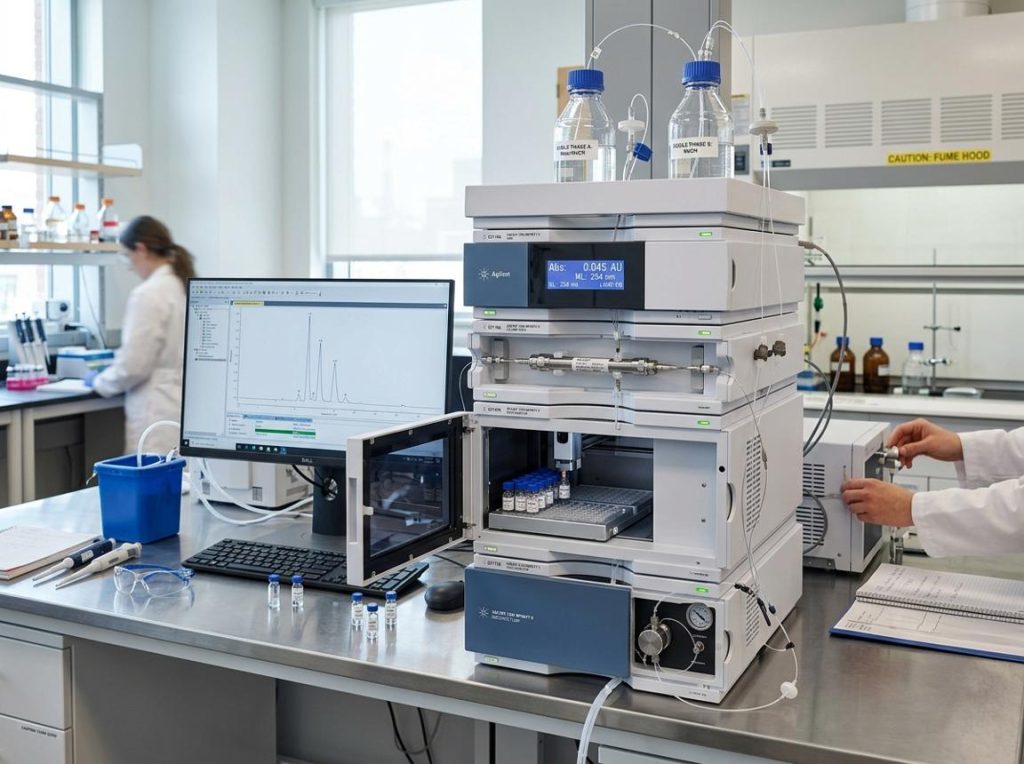
Synthesis answers whether a sequence can be built. Purification asks a different question entirely — whether one molecular species can be pulled out of the crowd of species that were built alongside it.
A peptide synthesis can succeed and still not produce a peptide. It produces a mixture.
That is not a failure of technique. It is a structural consequence of how the chemistry works. Solid-phase peptide synthesis assembles a chain by repeating one short cycle of reactions once per residue, and it is the dominant manufacturing route for peptides today.[1] Every one of those cycles is an opportunity for a reaction to run to something less than completion, or for a reaction nobody wanted to run at all. What comes off the resin at the end is the intended sequence accompanied by a population of closely related molecules — and no production route, chemical or biological, yields the target species exclusively.[2]
So the next problem is not can we make this peptide. It is the problem that the crude material from a peptide synthesis hands to whoever receives it: can the desired molecular species be separated from the other species produced alongside it?
That is what purification is. This article is about how it is done, why it is harder than it sounds, and — importantly — what it does not accomplish.
Why Does a Synthetic Peptide Need to Be Purified?
Because the material coming off the resin is a population, not a compound.
The species in that population arise from several independent sources, and a given synthesis will not contain all of them. Which ones appear depends on the sequence, the chemistry chosen and the conditions used. The recognised categories, though, are well characterised.[1]
Chains that are incomplete. If a coupling or a deprotection step does not go to completion in a given cycle, some fraction of the chains do not receive that residue. The result is a deletion sequence — the intended peptide, minus one or more residues from somewhere in the middle. A chain that stops growing altogether gives a truncation product.[1][2]
Chains that received too much. The mirror-image failure. Amino acid reagents used in excess can add a residue that was not called for, producing an insertion sequence.[1]
Chains that are chemically altered. Side chains can oxidise. Protecting groups can survive the step meant to remove them, leaving adducts. Reactive fragments released during cleavage can attach themselves to the peptide. Residues can epimerise, inverting the stereochemistry at a single carbon while changing nothing else about the molecule.[1][2]
Chains that have degraded. Peptides are not indefinitely stable, and several characteristic degradation routes — among them diketopiperazine, pyroglutamate and succinimide formation — generate their own family of related species.[1]
Chains that found each other. Dimeric and higher oligomeric species can form and appear alongside the monomeric target.[1]
What makes this a genuinely hard separation problem is not the number of species. It is their similarity. Many of these impurities differ from the target by a single amino acid, or by a single functional group, which means they also share most of its chemical properties.[2] A deletion sequence missing one small residue is, from the point of view of almost any physical separation, nearly the same molecule as the target. An epimerised peptide has the identical formula, the identical mass and nearly identical chemistry.
What Is Peptide Purification?
Purification is the separation of a desired molecular species from the other components of a mixture. That is the whole definition. It is worth stating plainly because purification is routinely conflated with two neighbouring operations that answer different questions.
Synthesis constructs. Purification separates. Characterization determines.
Three operations, three questions, three kinds of evidence. No one of them substitutes for another.
Synthesis asks: can this sequence be assembled? Its output is material. Purification asks: can the target species be separated from what accompanies it? Its output is enriched material. Characterization asks: what is actually in this container? Its output is not material at all — it is evidence.
Keeping these apart is the single most useful habit a reader of peptide documentation can acquire, and most of the rest of this article is an argument for why.
Why Chromatography Does This Work
Peptide purification is overwhelmingly chromatographic.[2][3] The reason is that chromatography is unusually good at exploiting small differences.
Every chromatographic system has two parts. A stationary phase stays put — typically a packed bed of porous particles carrying a particular surface chemistry. A mobile phase flows through it, carrying the sample along.
Each molecule in the sample is repeatedly distributed between the two. When it is associated with the stationary phase, it is not moving. When it is in the mobile phase, it travels at the speed of the flow. A molecule’s average velocity through the column is therefore set by how much of its time it spends in each state — which depends on how strongly that particular molecule interacts with the stationary phase relative to the mobile phase.[4]
This is the mechanism worth internalising: chromatography does not sort molecules by size or by any single property directly. It converts a difference in affinity into a difference in time. Two species that interact with the system even slightly differently will spend slightly different fractions of their journey immobilised, and will therefore arrive at the far end of the column at different moments. Given a long enough column and enough repetitions of that partitioning, a very small difference in affinity becomes a measurable difference in arrival time.
Retention, Selectivity, Resolution
Three terms describe what comes out of that process, and they are worth separating because they fail independently.
Retention is how long a species is held before it emerges. It is reported as a retention time, and it is a property of the molecule and the system together — the same peptide will show a different retention time under different conditions, which is why a retention time on its own identifies nothing.
Selectivity is whether the system distinguishes two species at all. If the target and an impurity happen to interact with a given stationary and mobile phase in the same way, they will travel together no matter how good the equipment is. Selectivity is a property of the chemistry chosen, and choosing it is most of method development.
Resolution is whether two species that are distinguished actually come out cleanly apart. Two peaks can be centred at different times and still overlap substantially, because each species does not arrive as an instant but as a spread-out band. Resolution combines how far apart two peaks are with how broad each one is.
A separation can fail at any of the three. No selectivity means the impurity is invisible to the method. Poor resolution means it is visible but not removable.
Why Reversed-Phase Chromatography Dominates Peptide Work
The mode most frequently used for purifying peptide mixtures is reversed-phase liquid chromatography, which separates species according to their hydrophobic character.[2]
The name is historical. Early chromatography used a polar stationary phase and a less polar mobile phase; reversing that arrangement — a nonpolar stationary phase, a more polar mobile phase — turned out to suit a great many molecules, peptides among them. A peptide in a mostly aqueous mobile phase will associate with a nonpolar surface; making the mobile phase progressively less polar over the course of the run weakens that preference until the peptide releases and travels on.
Two properties make this a good fit for peptide purification.
The first is that hydrophobicity is a composite property. A peptide’s retention reflects contributions from its constituent side chains, so two chains that differ by even one residue generally differ in retention. Those contributions have been measured directly: intrinsic hydrophilicity and hydrophobicity coefficients for the amino acid side chains have been determined from the reversed-phase retention behaviour of designed model peptides.[5] Usefully, that work also establishes the limits of the idea. The same study defines intrinsic coefficients as the values obtained in the absence of nearest-neighbour and conformational effects — an explicit acknowledgement that in a real peptide, neighbouring residues and the chain’s own folding modulate how fully a side chain expresses its character.[5] Sequence influences retention. It does not dictate it.
The second is sensitivity to small structural differences. Reversed-phase stationary phases can distinguish diastereomers — a peptide epimer, for instance, differing from the target only in the configuration of one residue. What they cannot do is separate enantiomers, which are not distinguishable by an achiral stationary phase at all.[2] This is a precise and useful boundary, and it is characteristic of purification generally: every method has a class of difference it is blind to.
Preparative Chromatography Is Not Analytical Chromatography
This distinction does more work than any other in understanding purification, and it is the point at which most general explanations of chromatography stop being relevant.
Analytical chromatography exists to produce information. A small amount of material is injected, the separation is run under conditions chosen to maximise clarity, and the output is a measurement. The sample is consumed. Nobody wanted it back.
Preparative chromatography exists to produce material.[6] The output is not a number but a collected fraction, and the point of the run is to recover as much of the target as possible in as pure a form as possible. That change of purpose changes the physics of the situation, because recovering a useful quantity means loading the column heavily — and heavily loaded columns behave differently from lightly loaded ones.
Under load, bands broaden and distort. Peaks that were baseline-separated at analytical scale begin to overlap. The classic situation in peptide polishing is a ternary one: the target elutes between a group of more weakly retained impurities and a group of more strongly retained ones, and because those impurities are chemically similar to the target, their peaks overlap it on both the leading and the trailing side. Increasing the load makes this worse.[2]
The consequence is that the operator is not choosing between a pure fraction and an impure one. They are choosing where to start and stop collecting from a continuous, partially overlapping signal.
Purity and Recovery Pull Against Each Other
That choice is the central trade-off of preparative purification, and it is worth being precise about it because it is frequently described in a way that suggests purification is simply a matter of trying harder.
Narrow the collection window around the apex of the target peak and the collected material contains proportionally less of the overlapping impurity — higher purity, at the cost of discarding target molecules that eluted in the shoulders. Widen the window and more of the target is recovered, but the impurity that co-elutes at the edges is collected with it. In batch chromatography, it is practically impossible to achieve both high purity and high yield simultaneously; the literature calls this the yield–purity trade-off.[2]
Two qualifications matter here.
The first is that this trade-off has no universal exchange rate. How much recovery a given increment of purity costs depends on the specific peptide, the specific impurities and how well the method separates them. A well-resolved separation makes the trade-off nearly free; a poorly resolved one makes it punishing. Any figure quoted as a general rule should be treated with suspicion.
The second is that the trade-off is a property of batch chromatography, not a law of nature. Continuous multicolumn processes — countercurrent solvent-gradient methods among them — exist specifically to relax it, by running the separation continuously over more than one column instead of as a single batch.[2] The constraint is real, and it is also engineered around.
What Happens to the Impurities?
Not all of them behave the same way, and the distinction the field draws is a useful one for a reader.
Some impurities are unrelated to the product — leftovers from the process that differ from the peptide substantially. These are comparatively easy to remove, because a method only needs to be crudely selective to separate things that are chemically unalike.
The difficult ones are product-related: the deletion sequences, the epimers, the modified forms. Removing these is a distinct stage — polishing — and it is much more challenging precisely because of their similarity to the target molecule.[2] A separation that easily strips out residual reagents may barely register the presence of a peptide missing one glycine.
When a single mode of chromatography cannot resolve a particular impurity, the standard response is orthogonality: run a second separation that sorts on a different property. Ion-exchange, hydrophilic-interaction and reversed-phase chromatography discriminate by charge, hydrophilicity and hydrophobicity respectively, so species that co-elute in one can separate in another.[2]
A published case makes the principle concrete. A 21-residue synthetic peptide was contaminated with versions of itself carrying acetyl groups on serine side chains — a modification small enough that reversed-phase chromatography alone could not resolve it, and cation-exchange alone could not either. A two-step protocol combining mixed-mode hydrophilic-interaction/cation-exchange chromatography with reversed-phase chromatography did separate them, by exploiting subtle differences in the local environment around each acetylation site.[7] One separation was insufficient. Two, chosen to be sensitive to different things, were enough.
Purification is not purely subtractive.
It can introduce material of its own — peptide counter ions, for instance, may originate in the purification treatment rather than the synthesis.[1]
That point deserves emphasis because it cuts against intuition. It is natural to picture purification as a filter that only ever removes. In practice the reagents used during purification participate in the chemistry of the sample, and what emerges carries traces of the process that produced it. Purification changes a material’s composition; it does not simply reduce it.
Why Some Peptides Are Harder to Purify Than Others
Purification difficulty varies widely, and the variation is not random. Several factors recur.
How similar the impurities are. This is the dominant factor. An impurity differing by one small residue, or by stereochemistry alone, sits closest to the target in almost every property a separation could exploit.[2] A published example of a demanding case is the purification of glucagon, a 29-residue peptide, from its epimer along with several other critical impurities arising from deamidation and racemisation.[2]
Hydrophobic character. Very hydrophobic peptides are not always best served by the reversed-phase surface chemistry used by default; alternatives with different retentive character can suit them better, which makes them a method-development problem rather than a routine one.[2]
Self-association. Peptides that associate with one another generate dimeric and higher oligomeric species, which appear as impurities in their own right and give the separation more to resolve.[1]
Instability. Degradation products form a recognised impurity group distinct from the synthesis by-products, so a peptide prone to those routes brings a second, independent source of related species to the same separation.[1]
There is also a factor that runs the other way, and it is one of the more elegant ideas in the field: purification difficulty can be anticipated during synthesis and designed around. If unreacted chains are chemically capped after each coupling step, they cannot rejoin the synthesis in a later cycle — and if the capping group is chosen to be something the separation can grab onto, the failure sequences become easy to remove. One implementation attaches a fluorous tag to unreacted amines, after which the failure products can be pulled out by fluorous chromatography.[8] The purification problem is easiest to solve when the synthesis was planned with it in mind.
What a Chromatogram Actually Shows
The output of a chromatographic run is a trace: detector signal against time. Peaks appear where material reached the detector. Their positions are retention times, their areas relate to how much material arrived, and the degree to which adjacent peaks are separated is the resolution.
That is genuinely informative. It is also narrower than it looks.
A chromatogram is evidence of chromatographic behaviour. It is not, by itself, a molecular identity test.
The clearest way to see the limit is to ask what a single symmetrical peak licenses you to conclude. It says that under these conditions, material reached the detector in one concentrated band at one time. It does not say that the band contained one species — only that whatever it contained was not separated by this method.
This is not a hypothetical concern. Establishing the purity of a main peak in a pharmaceutical peptide analysis is treated as its own analytical problem, addressed with two-dimensional liquid chromatography coupled to mass spectrometry precisely because a single reversed-phase separation cannot settle it.[9]
The reason those two techniques are combined is the most instructive detail in this whole subject. Each covers the other’s blind spot. Mass spectrometry cannot readily distinguish compounds sharing the same mass-to-charge ratio — isomers, and therefore epimers — which is exactly why such species must be resolved chromatographically instead.[9] And chromatography cannot reveal a co-eluting species of different mass hiding inside a peak, which is exactly what the mass spectrometer detects. Neither instrument is sufficient. The combination is strong because the failure modes do not overlap.
How chromatographic data is turned into a purity figure — what a percentage actually counts, and what it silently omits — is a large enough subject to deserve its own treatment, and the analytical use of HPLC is taken up separately.
Purification Is Not Characterization
Everything above concerns separating molecular species. None of it establishes what those species are.
Characterization is the set of measurements that establish what a material contains. Chromatographic methods contribute to it, but they are joined by others — mass spectrometry above all, which measures mass-to-charge ratios and, through fragmentation, can read sequence information directly.[10] Amino acid analysis, spectroscopic methods and content assays each answer questions the others cannot.
The relationship between the two operations is worth stating carefully. Purification improves a material. Characterization describes it. A well-purified material that has not been characterised is a material about which something is expected but nothing is established. And characterization is not a single measurement: identity, purity, stability and suitability for a given experiment are four different properties, and no single instrument reports all four.
Two of those questions — what a purity percentage means, and how identity is actually verified — are the subjects of later articles in this series.
Where Purification Sits in the Workflow
assembly many species separation one dominant species identity · purity · stability
Purification is one stage among several, and its position explains both its importance and its limits. It cannot fix a synthesis that assembled the wrong sequence — it can only enrich whatever was made. It cannot report on what it enriched. And it is not the last step: material that has been separated still has to be characterised, and characterisation may reveal that the enriched species was not the intended one.
Why This Matters for Research Quality
The practical reason to understand any of this is that experimental results are interpreted as though they concern a known material.
When they do not, the interpretation inherits the uncertainty. This is a documented concern rather than a theoretical one: peptide-related impurities have been noted as capable of influencing early functionality studies, with the potential for erroneous conclusions.[1]
The careful version of this claim is worth stating, because the careless version is common. Related species in a preparation do not automatically invalidate an experiment. Plenty of research is done with material of modest purity, entirely appropriately, because the question being asked is not sensitive to the difference. What impurities do is introduce an alternative explanation for whatever was observed — and the strength of that alternative depends on the experiment, the impurity and the magnitude of the effect. The point is not that impure material is useless. It is that knowing what a material contains is part of knowing what a result means.
What Purification Does Not Tell You
A short inventory, because these are routinely collapsed into one another:
| Question | Answered by | Not answered by |
|---|---|---|
| Was the target separated? | The purification itself | — |
| Is this the intended sequence? | Identity methods, mass spectrometry among them | Purification; retention time alone |
| How much of the sample is the target? | Quantitative analytical methods | The fact that material was purified |
| Will it stay that way? | Stability assessment over time and conditions | Any single measurement at one moment |
| Is it suitable for this experiment? | The experiment’s own requirements | A purity figure on its own |
No single number in the right-hand column of a certificate answers the row below it.
Conclusion
The useful mental model is a sequence of three distinct questions, each with its own kind of answer.
Synthesis asks whether a sequence can be constructed, and produces a mixture. Purification asks whether one species in that mixture can be separated from the others, and produces enriched material — subject to a trade-off between how pure the collected fraction is and how much of the target survives into it. Characterization asks what the enriched material actually contains, and produces evidence.
Reversed-phase chromatography does most of the second job, and it does it by turning small differences in molecular character into differences in arrival time. Its limits are the limits of that idea: species too similar to distinguish travel together, and species that travel together look like one thing.
Which is why the chromatogram — the most recognisable artefact of the whole process, the trace that so often stands in for quality — is the wrong place to stop. It records behaviour, not identity. Reading one properly, and knowing what a peak area does and does not count, is the subject of the next article in this series.
References
- D’Hondt M, Bracke N, Taevernier L, Gevaert B, Verbeke F, Wynendaele E, De Spiegeleer B. Related impurities in peptide medicines. J Pharm Biomed Anal. 2014;101:2–30. doi:10.1016/j.jpba.2014.06.012
- De Luca C, Lievore G, Bozza D, Buratti A, Cavazzini A, Ricci A, Macis M, Cabri W, Felletti S, Catani M. Downstream Processing of Therapeutic Peptides by Means of Preparative Liquid Chromatography. Molecules. 2021;26(15):4688. doi:10.3390/molecules26154688
- Mant CT, Chen Y, Yan Z, Popa TV, Kovacs JM, Mills JB, Tripet BP, Hodges RS. HPLC analysis and purification of peptides. Methods Mol Biol. 2007;386:3–55. doi:10.1007/978-1-59745-430-8_1
- Aguilar MI. HPLC of peptides and proteins: basic theory and methodology. Methods Mol Biol. 2004;251:3–8. doi:10.1385/1-59259-742-4:3
- Mant CT, Kovacs JM, Kim HM, Pollock DD, Hodges RS. Intrinsic amino acid side-chain hydrophilicity/hydrophobicity coefficients determined by reversed-phase high-performance liquid chromatography of model peptides: comparison with other hydrophilicity/hydrophobicity scales. Biopolymers. 2009;92(6):573–595. doi:10.1002/bip.21316
- Guiochon G. Preparative liquid chromatography. J Chromatogr A. 2002;965(1–2):129–161. doi:10.1016/S0021-9673(01)01471-6
- Litowski JR, Semchuk PD, Mant CT, Hodges RS. Hydrophilic interaction/cation-exchange chromatography for the purification of synthetic peptides from closely related impurities: serine side-chain acetylated peptides. J Pept Res. 1999;54(1):1–11. doi:10.1034/j.1399-3011.1999.00066.x
- Montanari V, Kumar K. Just add water: a new fluorous capping reagent for facile purification of peptides synthesized on the solid phase. J Am Chem Soc. 2004;126(31):9528–9529. doi:10.1021/ja0479033
- Petersson P, Buckenmaier S, Euerby MR, Stoll DR. A strategy for assessing peak purity of pharmaceutical peptides in reversed-phase chromatography methods using two-dimensional liquid chromatography coupled to mass spectrometry. Part I: Selection of columns and mobile phases. J Chromatogr A. 2023;1693:463874. doi:10.1016/j.chroma.2023.463874
- Steen H, Mann M. The ABC’s (and XYZ’s) of peptide sequencing. Nat Rev Mol Cell Biol. 2004;5(9):699–711. doi:10.1038/nrm1468
The Dice Journal publishes research-focused content on peptide science. Nothing in this article constitutes medical advice, a therapeutic claim, or guidance on the use of research compounds. Research peptides are laboratory materials intended for research use only and are not approved treatments.
Leave a Reply